

Every shade and texture of every product has to be digitised accurately before it can be rendered on a face.
For a brand with tens of thousands of SKUs, that's historically meant months of manual work: hex codes typed into spreadsheets, multiple packshot uploads and constant guesswork on product calibrations, before anything goes live.
So we built an AI agent to do the work properly. Point it at a product URL, and it deeply analyses the entire page, running image analysis to find the actual packshot, ignoring lifestyle shots and swatches.
It reads the product page context to extract shade variants, estimates accurate colour values from the imagery, and matches the right material texture.
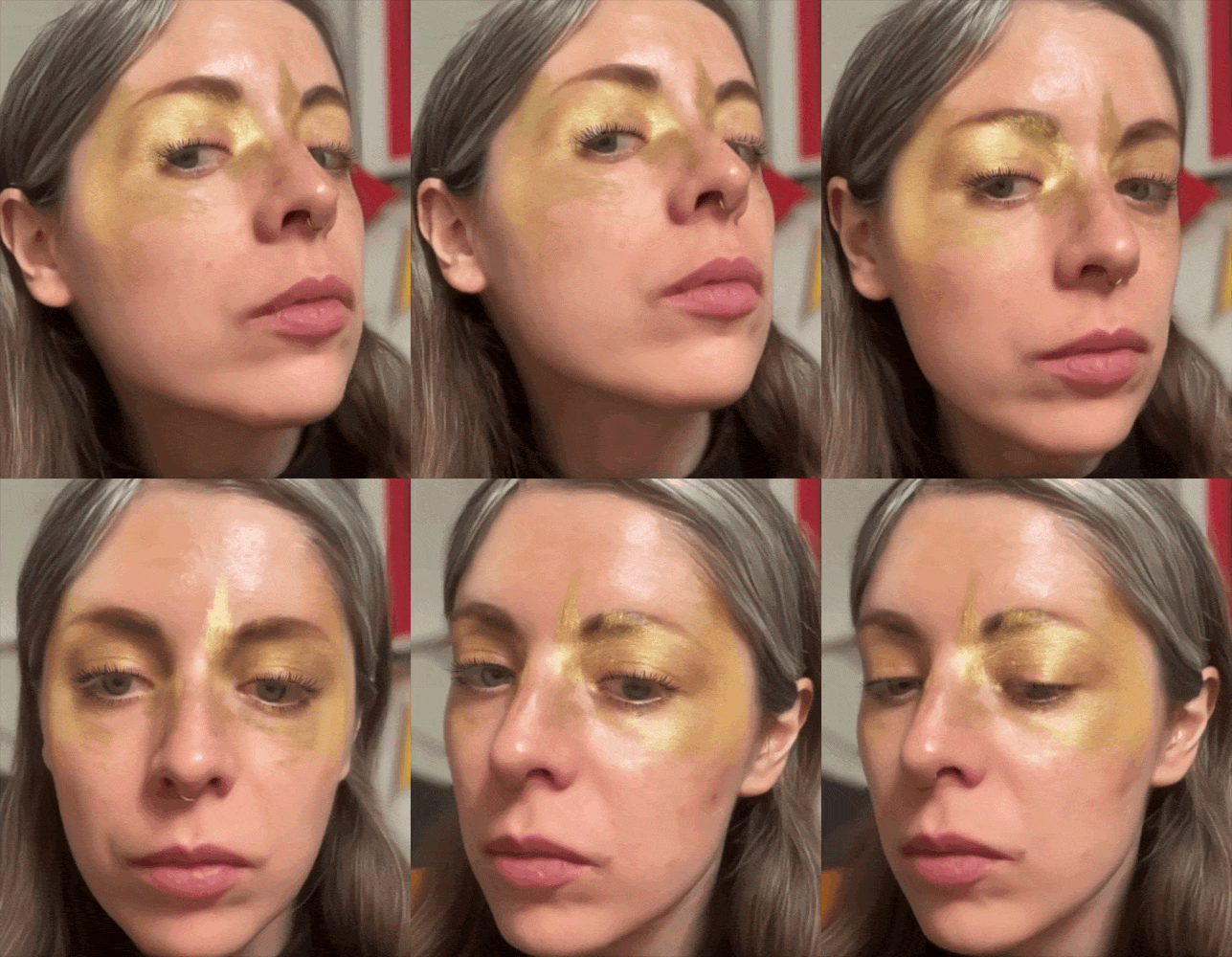
Texture is the part most virtual try-on experiences get wrong. A matte lipstick, a glossy lacquer, and a metallic finish can share similar colour values in a swatch, but render completely differently on a face under real lighting.
Getting that mapping right is the difference between a try-on that looks credible and one that gives itself away in the first second.
As part of our Neo™ range of SaaS products at Beauty by Holition, our AI Auto-Calibrator add-on now handles product onboarding end-to-end.
A full catalogue, ready for live deployment in minutes. No manual data entry, no spreadsheets.
Our AI Auto-Calibrator add-on lets brands integrate products and deploy virtual try-on experiences in minutes.
.gif)
AI-assisted Colour Extraction
Analyses product images to extract shade and texture parameters with minimal manual refinement.
Intelligent Metadata Capture
Automatically extracts product details and specifications from existing content
Streamlined Calibration Process
Going from a manual process to an AI driven automated process with the human in the loop.
Virtual try-on used to be a 2D colour overlay. A digital filter dropped on top of a face.

But the latest generation of 3D virtual beauty experiences, such as Neo™’s range of intelligent beauty SaaS products, is evolving into something much more sophisticated:
Predictive rendering systems and hyper-realistic virtual try-on tools capable of simulating real-world variables like ambient lighting, skin texture and cosmetic finish, and intelligent beauty tools, powered by AI, that act as your customers’ trusted beauty and skincare companion.
Hex codes alone are no longer enough. You need calibrated material properties, texture intelligence and richer per-shade datasets, across thousands of SKUs, kept in sync with new launches, across global catalogues.
Without automation, that work doesn't happen at scale. Brands either ship a thin slice of their catalogue, or they ship inaccurate renders.
Neither is acceptable when 71% of consumers already expect personalised interactions from the companies they buy from (McKinsey, 2025), and the AI beauty personalisation market is projected to grow from $2.3 billion in 2026 to $16.4 billion by 2036 (Future Market Insights).
That means building systems capable of transforming product catalogues into intelligent, deployable digital assets automatically. It means reducing onboarding from months to minutes.
It also means treating virtual try-on and other intelligent beauty experiences not as a simple marketing activation, but as a foundational commerce layer that can increase engagement, deepen consumer trust and translate into real sales.


The names Holition® and Beauty by Holition™ are registered and unregistered trade marks of Holition Limited and may not be used or copied without prior written consent. All text, graphics, images, artwork, computer code and related information on this website (collectively, "Content"), including but not limited to its design, look and feel and arrangement or display of the Content belongs to Holition and such Content is protected by copyright, patent and trade mark registration law nationally and internationally.